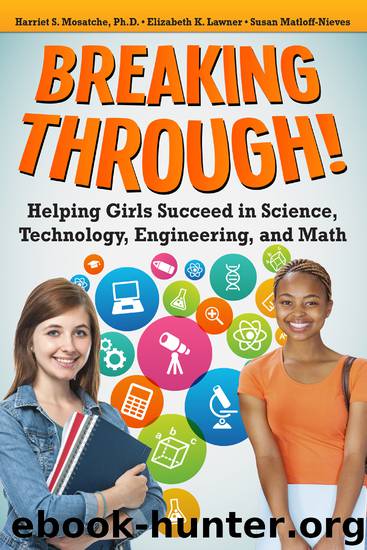
Breaking Through! by Harriet Mosatche
Author:Harriet Mosatche
Language: eng
Format: epub
Publisher: Sourcebooks
“Anything my parents did with my brothers, they did with me. It wasn’t like my brothers learned how to change the oil in a car and I learned to cook. That’s what made the most difference for me because my parents did things equally with me and my brothers.”
—Gail Ruby, MS in computer science, senior product manager at Motor Information Systems, Michigan
M and M: Math and Money
Regardless of what girls do in their lives, they need to know about budgeting and banking. And that means being competent and comfortable with math. Give your daughter a head start by using math concepts at a very early age, not for the purpose of pushing her ahead, but to help her feel comfortable with math before she faces the kind of stereotyping and gender bias that might undermine her confidence.
Math concepts in everyday situations. If you’re talking to a toddler or preschooler, use comparative terms such as bigger or smaller. Ask questions or make comments about a toy’s size, and use hand gestures to emphasize the difference between “just a little” and “a lot.” When you’re setting the table, ask for one more spoon or two more bowls. Or say something like, “We are only three people, but we have four plates. Let’s put one away.” Maybe when you’re cutting up a favorite dessert, purposely make the portions a bit uneven. Then you can ask, “Who should get the largest piece?” and “Which is the smallest piece?”
Lots of parents express pride when their children at a very young age can count to 10 or 20. But if the counting is just based on rote memorization, it doesn’t really mean much. Instead, focus on helping your daughter to understand that three is greater than two and that three is less than four. Use concrete objects to make your point, and show that using math is a part of everyday life. Probability games are fun and only require a single coin. Ask your daughter to predict how often a coin will land heads or tails up if you toss it 100 times. Then discuss your findings.
Math is a vital part of music. Whether you’re dancing to a particular tempo or recognizing that one note is held twice as long as the one before, you’re using math. Dance steps are timed, and when the music speeds up, those steps have to keep up. Musical instruments have a certain number of strings or keys. Make sure your daughter sees that math is not only all around her, but that it also plays a role in the beauty of the world.
Keeping score in board games, such as Monopoly, requires math skills. Even word games such as Scrabble use math when comparing possible moves—would it be better to take advantage of a triple letter tile or a double word tile? Strategy games such as dominoes, checkers, chess, and Parcheesi boost mathematical thinking, memory, sequencing skills, and spatial skills.
Download
This site does not store any files on its server. We only index and link to content provided by other sites. Please contact the content providers to delete copyright contents if any and email us, we'll remove relevant links or contents immediately.
The Art of Coaching Workbook by Elena Aguilar(51201)
Trainspotting by Irvine Welsh(21668)
Twilight of the Idols With the Antichrist and Ecce Homo by Friedrich Nietzsche(18635)
Fangirl by Rainbow Rowell(9253)
Periodization Training for Sports by Tudor Bompa(8273)
Change Your Questions, Change Your Life by Marilee Adams(7783)
This Is How You Lose Her by Junot Diaz(6888)
Asking the Right Questions: A Guide to Critical Thinking by M. Neil Browne & Stuart M. Keeley(5775)
Grit by Angela Duckworth(5615)
Red Sparrow by Jason Matthews(5475)
Paper Towns by Green John(5191)
Room 212 by Kate Stewart(5123)
Ken Follett - World without end by Ken Follett(4734)
Housekeeping by Marilynne Robinson(4449)
The Sports Rules Book by Human Kinetics(4388)
Papillon (English) by Henri Charrière(4274)
Double Down (Diary of a Wimpy Kid Book 11) by Jeff Kinney(4273)
The Motorcycle Diaries by Ernesto Che Guevara(4102)
Exercise Technique Manual for Resistance Training by National Strength & Conditioning Association(4071)
